—— 要投稿,上万维,轻松学术交流

严正声明

本站非期刊官网,非中介代理,
不向作者收取任何费用!
举报微信:13140028228 冯老师

态度公正、信息求实、投稿自助、使用免费
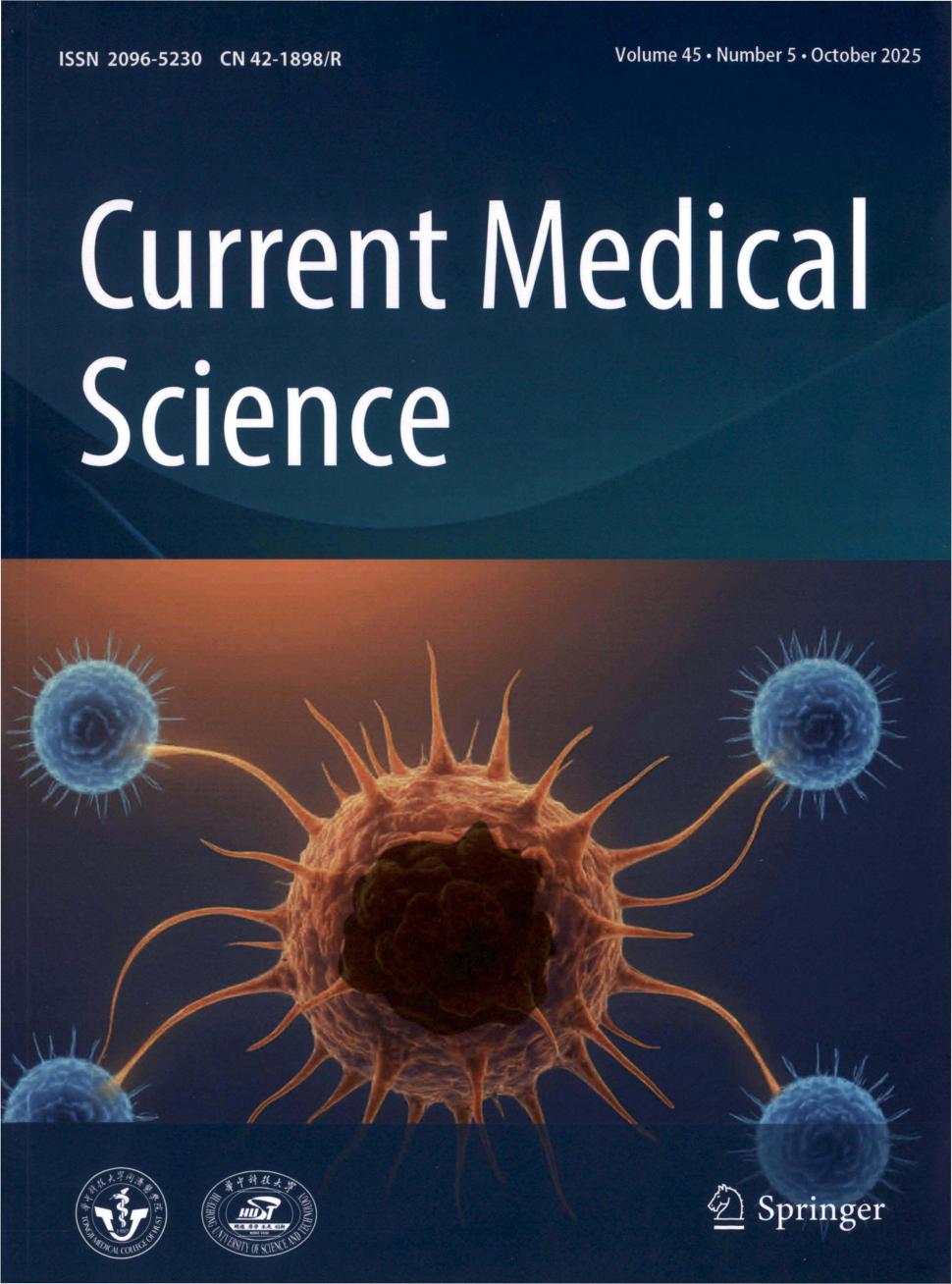
当代医学科学(英文)(Current Medical Science)(原:华中科技大学学报(医学英德文版))
CN外文 - 双月刊
  • 当代医学科学(英文)(Current Medical Science)(原:华中科技大学学报(医学英德文版))
  • 复合影响因子:0.979
  • CSCD(2025-2026)
  • 知网外文库,万方,维普
  • /有基金 100.0%
  投稿方式:官网投稿
  • 栏目频次
  • 一作占比
  • 单位占比
  • 热词

低频栏目

16.7%期平均发文量27篇
16.7%期平均发文量2篇
16.7%期平均发文量25篇
16.7%期平均发文量1篇
16.7%期平均发文量28篇
16.7%期平均发文量24篇
16.7%期平均发文量1篇
16.7%期平均发文量26篇
16.7%期平均发文量23篇
100.0%
暂无单位信息.
暂无关键词信息.
  • 更多

    期刊简介

  • 《当代医学科学(英文)》(Current Medical Science)(双月刊)创刊于1979年,2018年更为现刊名,由华中科技大学主办。主要刊登基础医学、临床医学、预防医学、环境医学、法医学、药学等方面的论文。主要栏目:论著、经验交流、技术交流、论文摘要、病例报告、短篇报道。

  • 基本信息

  • 期刊名称:当代医学科学(英文)(Current Medical Science)(原:华中科技大学学报(医学英德文版))
  • 主管单位:教育部
  • 主办单位:华中科技大学
  • 国内刊号:CN 42-1898/R
  • 国际刊号:ISSN 2096-5230;EISSN2523-899X
  • 出刊日期:
    期刊定价:
  • 邮发代码:
  • 所在省区:湖北
    邮政编码:
  • 联系地址:

  • 投稿信息

  • 学科分类:基础医学
    版面费用:待核实
  • 字数要求:12000-20000
    查重要求:-
  • 复合因子:0.979
    综合因子:0.705
  • 审  稿 费:
    稿费:待核实
  • 本刊可发:
  • 特殊属性:第一批认定学术期刊,外文期刊

  • 联系方式

  • 投稿网址:https://www2.cloud.editorialmanager.com/tcms/default2.aspx
  • 官网网址:https://www.springer.com/journal/11596
  • 电话传真:027-83692927;83693211(微信公众号信息)
  • 电子邮箱:cms-em@hust.edu.cn(微信公众号信息)
  • 微信公众号:Current Medical Science(Dangdaiyixuekexue)

审稿时间:暂无参考数据,审稿时间不确定!

投稿难度:网友分享,仅供参考

见刊周期:-

温馨提示以上只是参考信息,实际情况会根据投稿主题、稿件质量和数量、审稿流程有所差异。想获得更准确信息请联系期刊的编辑部进行咨询。

欢迎点评!让信息更透明,使投稿更轻松!
    • 审稿时间:
      是否录用:
    • 发表排期:
      查重要求:
    • 有无课题:
      有无回复:
    • 我的学历:
      我的职称:
    • 审稿费用:
      版面费用:
    • 稿       费:
      稿件字数:
    • 投稿难度:
    • 该刊可发:
    • 投稿主题:
匿名: 验证码: 点击切换验证码
    • 1、投稿方式:在线投稿。

      2、刊内网址(202505期):

      https://www.springer.com/journal/11596

      自动跳转至:

      https://link.springer.com/journal/11596/

      3、投稿系统:

      https://www2.cloud.editorialmanager.com/tcms/default2.aspx

      4、联系邮箱:cms-em@hust.edu.cn

      (微信公众号信息)

      5、联系电话:027-83692927;83693211

      (微信公众号信息)

      6、出刊日期:双月刊,逢双月出版。

      7、刊内微信公众号:Current Medical Science(Dangdaiyixuekexue)

      2026年1月29日星期四

      Submission guidelines

      【官网信息】

      Instructions for Authors

      Types of Papers

      Current

      Medical Science welcomes a variety of paper types, including original

      article, review, commentary, perspective, guideline, consensus article,

      that align with our scope. All submissions must adhere to the following

      guidelines to ensure they meet our journal's standards:

      Title and Abstract: Should be clear, concise, and reflective of the study's content.

      Main

      Text: The manuscript should be written in clear and concise English,

      with proper grammar and punctuation. Non-native English speakers are

      encouraged to have their manuscripts professionally edited for language.

      Figures

      and Tables: All figures and tables must be clear, legible, and

      appropriately labeled. They should complement, not duplicate, the text.

      References: Include the most relevant and recent references in the field.

      References

      should be cited in Vancouver style, with numbers corresponding to their

      order in the text, followed by the reference list in numerical order at

      the end of the manuscript.

      For

      each reference, list the first three authors' surnames in full and the

      initials of each of their given names without spaces. If there are more

      than three authors, list the first three followed by "et al.".

      We

      encourage authors to use reference managers such as EndNote, Zotero and

      Mendeley to minimize errors. This will significantly enhance the

      efficiency of paper publication.

      Original Article:

      An

      original and complete study that provides a full account of the

      research process, results, and conclusions. It should be innovative,

      outstanding and influential.

      -Structured Abstract: Not exceeding 400 words. Divided into Objective, Methods, Results, and Conclusion sections.

      -Main Text: Better not exceeding 8,000 words, excluding abstract, references, figures and tables. Should be divided into:

      INTRODUCTION

      MATERIALS AND METHODS

      RESULTS

      DISCUSSION

      CONCLUSIONS

      Brief Report:

      A

      focused study that presents key findings in a concise manner, offering a

      snapshot of the research without the full details of a comprehensive

      study. The findings should be innovative and significant.

      -Structure and Length:

      With the same structure with Original Article. Abstract not exceeding

      300 words, main text not exceeding 2000 words, and no more than 20

      references.

      -Reminder:

      Given our limited space and high standards for this category, authors

      are strongly encouraged to contact the editorial team for confirmation

      before submitting a Brief Report.

      Review:

      Comprehensive

      works that provide an in-depth analysis of a special topic, summarizing

      current knowledge, including recent developments, and may offer

      suggestions for future research directions. Systematic reviews should

      follow the PRISMA reporting guidelines.

      -Abstract:

      Not exceeding 400 words. Non-structured abstracts are acceptable for

      regular reviews, while structured abstracts are recommended for system

      reviews.

      -Main

      Text: Better not exceeding 8,000 words, excluding abstract, references,

      figures and tables. Should contain ‘INTRODUCTION’ and ‘CONCLUSIONS’

      sections. The body structure can be flexible, divided into subheadings

      as appropriate, allowing for a comprehensive exploration of the topic.

      -Illustrations are strongly encouraged.

      Perspective:

      Perspective

      pieces that provide a broad and in-depth analysis of a topic, offering

      unique viewpoints, insights, and interpretations that extend beyond the

      findings of original research.

      -Abstract: Not exceeding 300 words. Non-structured abstracts are acceptable.

      -Main

      Text: Not exceeding 4,000 words. Should include an ‘INTRODUCTION’

      section. The body structure can be flexible, organized as appropriate.

      Editorial and Commentary:

      Opinion

      pieces that offer analysis, critique, or recommendations on recent

      publications or developments within the field. These articles are short,

      concise, and narrowly focused.

      -Structure

      & Length: Abstracts are NOT required. The body section can be

      freely structured to directly address the topic, not exceeding 2,000

      words. Include no more than 10 references, focusing on the most recent

      and directly relevant literature.

      -Peer

      Review: These articles are generally not peer-reviewed or may only be

      sent to the authors of the commented publications for response.

      -Submission:

      Editorials and Commentaries are typically by invitation only. However,

      unsolicited submissions of Commentaries can also be considered when

      space allows.

      Guidelines:

      Articles

      that provide evidence-based recommendations for clinical research and

      practice, or public health policy. Guidelines should be developed

      through a rigorous process and provide clear, actionable advice.

      -Abstract: Non-structured abstracts are acceptable

      -Contents:

      The guidelines should include a brief overview, evidence-based

      recommendations graded by strength, evidence summaries (possibly

      supplemented with tables/figures), an analysis of implications,

      benefits, and limitations, and practical implementation advice.

      -Length:

      While the length of guidelines can vary, they should be concise and

      focused. Striking a balance between comprehensiveness and brevity

      ensures user-friendliness without missing essential details.

      consensus articles:

      Documents

      that reflect the collective opinion of leading experts on a particular

      topic, often developed through consensus meetings or collaborative

      efforts. These papers should outline the rationale behind the consensus

      and its implications for the field.

      -Abstract: Non-structured abstracts are acceptable.

      -Length: Not exceeding 8000 words excluding abstract, references, figures and tables.

      ......

      更多详见:

      https://link.springer.com/journal/11596/submission-guidelines


    验证码: 点击切换验证码