—— 要投稿,上万维,轻松学术交流

严正声明

本站非期刊官网,非中介代理,
不向作者收取任何费用!
举报微信:13140028228 冯老师

态度公正、信息求实、投稿自助、使用免费
工程微生物学(英文)(Engineering Microbiology)(OA期刊)(不收版面费)
CN外文 - 季刊
  • 工程微生物学(英文)(Engineering Microbiology)(OA期刊)(不收版面费)
  • 复合影响因子:0
  • CSCD(2025-2026)科技核心(2025学术卷)
  • 知网,万方目次,维普目次
  • /有基金 100.0%
  投稿方式:官网投稿
  • 栏目频次
  • 一作占比
  • 单位占比
  • 热词

低频栏目

16.7%期平均发文量10篇
16.7%期平均发文量11篇
16.7%期平均发文量10篇
16.7%期平均发文量7篇
16.7%期平均发文量6篇
16.7%期平均发文量6篇
100.0%
暂无单位信息.
暂无关键词信息.
  • 更多

    期刊简介

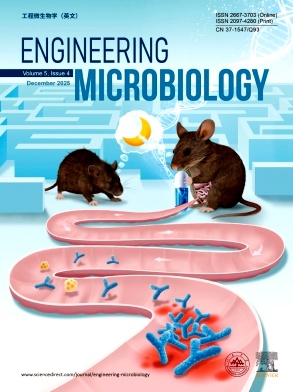
  • 《工程微生物学(英文)》(Engineering Microbiology)(季刊),创刊于2021年,是由教育部主管,山东大学主办,山东大学科技期刊社和爱思唯尔联合出版,微生物改造技术全国重点实验室承办的一本开放获取国际期刊。期刊以提高微生物的产业应用价值为导向,致力于发表微生物领域高水平、创新型研究成果。

  • 基本信息

  • 期刊名称:工程微生物学(英文)(Engineering Microbiology)(OA期刊)(不收版面费)
  • 主管单位:教育部
  • 主办单位:山东大学
  • 国内刊号:CN37-1547/Q93
  • 国际刊号:ISSN 2097-4280;EISSN 2667-3703
  • 出刊日期:
    期刊定价:
  • 邮发代码:
  • 所在省区:山东
    邮政编码:
  • 联系地址:

  • 投稿信息

  • 学科分类:生物科学
    版面费用:不收版面费
  • 字数要求:[]14000-28000
    查重要求:- ;AIGC检测:-
  • 复合因子:0
    综合因子:0
  • 审  稿 费:
    稿费:待核实
  • 审稿类型:默认
    是否加急:
  • 本刊可发:
  • 特殊属性:外文期刊

  • 联系方式

  • 投稿网址:https://www.editorialmanager.com/ENGMIC/default.aspx
  • 官网网址:https://www.sciencedirect.com/journal/engineering-microbiology
  • 电话传真:0532-58631619(202504期)
  • 电子邮箱:engmicro@email.sdu.edu.cn(202504期)
  • 微信公众号:工程微生物学

审稿时间:暂无参考数据,审稿时间不确定!

投稿难度:网友分享,仅供参考

见刊周期:-

温馨提示以上只是参考信息,实际情况会根据投稿主题、稿件质量和数量、审稿流程有所差异。想获得更准确信息请联系期刊的编辑部进行咨询。

欢迎点评!让信息更透明,使投稿更轻松!
    • 审稿时间:
      是否录用:
    • 发表排期:
      查重要求:
    • 有无课题:
      有无回复:
    • 我的学历:
      我的职称:
    • 审稿费用:
      版面费用:
    • 稿       费:
      稿件字数:
    • 投稿难度:
    • 该刊可发:
    • 投稿主题:
匿名: 验证码: 点击切换验证码
    • 1、投稿方式:在线投稿。

      2、刊内网址(202504期):

      https://www.sciencedirect.com/journal/engineering-microbiology

      3、投稿系统:

      https://www.editorialmanager.com/ENGMIC/default.aspx

      4、山东大学科技期刊社:http://njournal.sdu.edu.cn/

      5、刊内邮箱:engmicro@email.sdu.edu.cn

      6、刊内电话:0532-58631619

      7、出刊日期:季刊,逢季末月出版。

      8、官方微信公众号:工程微生物学

      9、微信公众号信息:免收开放获取的出版费用。

      2025年12月3日星期三

      Guide for authors

      【官网信息】

      Introduction

      Types of article

      The

      Engineering Microbiology journal publishes full length original

      research papers, review type articles, short communications, research

      highlights as well as news and commentaries.

      Research

      Papers are not limited in size. However, we do strongly recommend to

      authors to keep the main body of text (excluding abstract,

      tables/figures, and references) not to exceed 6,000 words

      Short

      Communications have the following soft limits. This format may not

      exceed 4 printed pages. The manuscript should ideally contain the title

      page, all sections of the manuscript (including the references), and

      Figure/Table legends. The abstract should be limited to 75 words.

      Review Articles Length: a maximum word count of 12,000 and may contain no more than 15 Figures/Tables

      Research

      Highlights are short articles that describe, analyze and discuss the

      latest cutting-edge research findings published either in Engineering

      Microbiology or somewhere else. Article submission is, in most cases,

      invited from the editorial board and are not peer-reviewed. These

      articles usually have three sections: abstract, main text and cited

      references. The length is typically 2-3 printed pages, although some may

      be longer.

      News

      are short articles in news format. They report the latest research

      progresses in the key areas of the contemporary microbiology, or any

      commercial, ethical, legal, societal news related to the microbiology

      research field.

      Commentaries

      are short focused essays reporting analysis of recently published

      articles on hot topics of immediate importance to the microbiology

      field. These articles are, in most cases, submitted by invitation. The

      length may not exceed 3 printed pages, exclusive of references.

      Submission checklist

      You

      can use this list to carry out a final check of your submission before

      you send it to the journal for review. Please check the relevant section

      in this Guide for Authors for more details.

      Ensure that the following items are present:

      One author has been designated as the corresponding author with contact details:

      • E-mail address

      • Full postal address

      All necessary files have been uploaded:

      Manuscript:

      • Include keywords

      • All figures (include relevant captions)

      • All tables (including titles, description, footnotes)

      • Ensure all figure and table citations in the text match the files provided

      • Continuous line numbers should be included

      • Indicate clearly if color should be used for any figures in print

      Graphical Abstracts / Highlights files (where applicable)

      Supplemental files (where applicable)

      Further considerations

      • Manuscript has been 'spell checked' and 'grammar checked'

      • All references mentioned in the Reference List are cited in the text, and vice versa

      • Permission has been obtained for use of copyrighted material from other sources (including the Internet)

      • A competing interests statement is provided, even if the authors have no competing interests to declare

      • Journal policies detailed in this guide have been reviewed

      • Referee suggestions and contact details provided, based on journal requirements

      For further information, visit our Support Center.

      Essential Figure Requirements for Revision & Publication

      Figures should be cited in numerical order in the text in the order they are mentioned.

      Compliance

      with the following standards at the time of initial submission is

      strongly encouraged to prevent delays during the revision and production

      phases:

      1. Figure Dimensions (Maximum):

      Figures should be prepared at their final publication size. The final dimensions must NOT EXCEED:

      Width:

      Single-column: 85 mm (≈3.35 in)

      Double-column: 178 mm (≈7.01 in)

      Height: 228 mm (≈8.98 in) for both single and double-column figures.

      Image Quality & Format:

      Resolution: Minimum 300 PPI at final size.

      Color Mode: Use RGB for color figures.

      File Formats: Submit as TIFF, EPS or PDF files.

      Tip:

      To avoid blurry images, ensure resolution is high enough before setting

      the final dimensions. Enlarging a small image will reduce quality.

      3. Text Formatting:

      Font: Use only standard fonts (e.g., Arial, Times New Roman, Courier New, Symbol).

      Size: 8 pt for all primary text. 5 pt for subscript and superscript characters.

      Important: Do not convert text to outlines or paths.

      4. Line Weight:

      All lines, axis lines, borders, and strokes must have a weight between 0.5 pt and 1.0 pt to ensure clarity upon publication.

      5. Panel Identification:

      Multi-panel

      figures must be labeled sequentially with lowercase, bold letters

      (e.g., a, b, c) in the top-left corner of each panel.

      The font size for all labels is 12 pt, bold.

      Important:

      These labels must be added after all panels have been assembled and

      scaled to their final publication size to prevent misalignment or

      scaling errors during processing.

      6. Error Bars:

      Any

      graphical representation of quantitative data derived from three or

      more independent experiments must display error bars on the measured

      values. The nature of the error (e.g., standard deviation [SD], standard

      error of the mean [SEM]) must be explicitly defined in the figure

      legend.

      Authors

      should provide clear, detailed descriptions of their statistical

      analysis in the Materials and methods section and/or figure legends,

      including, but not limited to, the statistical test used, actual

      p-values, number of biological and technical replicates, measure of

      center, and measure of variability.

      Before you begin

      Studies in humans and animals

      If

      the work involves the use of human subjects, the author should ensure

      that the work described has been carried out in accordance with The Code

      of Ethics of the World Medical Association (Declaration of Helsinki)

      for experiments involving humans. The manuscript should be in line with

      the Recommendations for the Conduct, Reporting, Editing and Publication

      of Scholarly Work in Medical Journals and aim for the inclusion of

      representative human populations (sex, age and ethnicity) as per those

      recommendations. The terms sex and gender should be used correctly.

      The

      author should ensure that the manuscript contains a statement that all

      procedures were performed in compliance with relevant laws and

      institutional guidelines and have been approved by the appropriate

      institutional committee(s). This statement should contain the date and

      reference number of the ethical approval(s) obtained. Authors should

      also include a statement in the manuscript that informed consent was

      obtained for experimentation with human subjects. The privacy rights of

      human subjects must always be observed.

      The

      journal will not accept manuscripts that contain data derived from

      unethically sourced organs or tissue, including from executed prisoners

      or prisoners of conscience, consistent with recommendations by Global

      Rights Compliance on Mitigating Human Rights Risks in Transplantation

      Medicine. For all studies that use human organs or tissues authors must

      provide sufficient evidence that they were procured in line with WHO

      Guiding Principles on Human Cell, Tissue and Organ Transplantation. The

      source of the organs or tissues used in clinical research must be

      transparent and traceable. Authors of manuscripts describing organ

      transplantation must additionally declare within the manuscript:

      that autonomous consent free from coercion was obtained from the donor(s) or their next of kin; and

      that organs/tissues were not sourced from executed prisoners or prisoners of conscience.

      All

      animal experiments should comply with the ARRIVE guidelines and should

      be carried out in accordance with the U.K. Animals (Scientific

      Procedures) Act, 1986 and associated guidelines, EU Directive 2010/63/EU

      for animal experiments, or the National Research Council's Guide for

      the Care and Use of Laboratory Animals and the authors should clearly

      indicate in the manuscript that such guidelines have been followed. The

      sex of animals must be indicated, and where appropriate, the influence

      (or association) of sex on the results of the study.

      Declaration of competing interest

      Corresponding

      authors, on behalf of all the authors of a submission, must disclose

      any financial and personal relationships with other people or

      organizations that could inappropriately influence (bias) their work.

      Examples of potential conflicts of interest include employment,

      consultancies, stock ownership, honoraria, paid expert testimony, patent

      applications/registrations, and grants or other funding. All authors,

      including those without competing interests to declare, should provide

      the relevant information to the corresponding author (which, where

      relevant, may specify they have nothing to declare). Corresponding

      authors should then use this tool to create a shared statement and

      upload to the submission system at the Attach Files step. Please do not

      convert the .docx template to another file type. Author signatures are

      not required.

      Only

      the content in the separate declaration of competing interest file that

      you submit to the submission system will be published, so there is no

      need to repeat the statement in the manuscript file.

      Declaration of generative AI in scientific writing

      Authors must declare the use of generative AI in the manuscript preparation process upon submission of the paper.

      Elsevier

      recognizes the potential of generative AI and AI-assisted technologies

      (“AI Tools”), when used responsibly, to help researchers work

      efficiently, gain critical insights fast and achieve better outcomes.

      Increasingly, these tools, including AI agents and deep research tools,

      are helping researchers to synthesize complex literature, provide an

      overview of a field or research question, identify research gaps,

      generate ideas, and provide tailored support for tasks such as content

      organization and improving language and readability.

      Authors

      preparing a manuscript for an Elsevier journal can use AI Tools to

      support them. However, these tools must never be used as a substitute

      for human critical thinking, expertise and evaluation. AI technology

      should always be applied with human oversight and control.

      Ultimately, authors are responsible and accountable for the contents of their work. This includes accountability for:

      Carefully

      reviewing and verifying the accuracy, comprehensiveness, and

      impartiality of all AI-generated output (including checking the sources,

      as AI-generated references can be incorrect or fabricated).

      Editing

      and adapting all material thoroughly to ensure the manuscript

      represents the author’s authentic and original contribution and reflects

      their own analysis, interpretation, insights and ideas.

      Ensuring

      the use of any tools or sources, AI-based or otherwise, is made clear

      and transparent to readers. If AI Tools have been used, we require a

      disclosure statement upon submission; please see example below.

      Ensuring

      the manuscript is developed in a way that safeguards data privacy,

      intellectual property and other rights, by checking the terms and

      conditions of any AI tool that is used.

      Finally,

      authors must not list or cite AI Tools as an author or co-author on the

      manuscript since authorship implies responsibilities and tasks that can

      only be attributed to, and performed by, humans.

      The

      use of AI Tools in the manuscript preparation process must be declared

      by adding a statement at the end of the manuscript when the paper is

      first submitted. The statement will appear in the published work and

      should be placed in a new section before the references list.

      An example:

      Title of new section: Declaration of generative AI and AI-assisted technologies in the manuscript preparation process.

      Statement:

      During the preparation of this work the author(s) used [NAME OF TOOL /

      SERVICE] in order to [REASON]. After using this tool/service, the

      author(s) reviewed and edited the content as needed and take(s) full

      responsibility for the content of the published article.

      The

      declaration does not apply to the use of basic tools, such as tools

      used to check grammar, spelling and references. If you have nothing to

      disclose, you do not need to add a statement.

      Please

      read Elsevier’s author policy on the use of generative AI and

      AI-assisted technologies, which can be found in our generative AI

      policies for journals.

      Please

      note: to protect authors’ rights and the confidentiality of their

      research, this journal does not currently allow the use of generative AI

      or AI-assisted technologies such as ChatGPT or similar services by

      reviewers or editors in the peer review and manuscript evaluation

      process, as is stated in our generative AI policies for journals. We are

      actively evaluating compliant AI Tools and may revise this policy in

      the future.

      Submission declaration and verification

      Submission

      of an article implies that the work described has not been published

      previously (except in the form of an abstract, a published lecture or

      academic thesis, see 'Multiple, redundant or concurrent publication' for

      more information), that it is not under consideration for publication

      elsewhere, that its publication is approved by all authors and tacitly

      or explicitly by the responsible authorities where the work was carried

      out, and that, if accepted, it will not be published elsewhere in the

      same form, in English or in any other language, including electronically

      without the written consent of the copyright-holder. To verify

      compliance, your article may be checked by Crossref Similarity Check and

      other originality or duplicate checking software.

      Preprints

      Please

      note that preprints can be shared anywhere at any time, in line with

      Elsevier's sharing policy. Sharing your preprints e.g. on a preprint

      server will not count as prior publication (see 'Multiple, redundant or

      concurrent publication' for more information).

      ......

      更多详情:

      https://www.sciencedirect.com/journal/engineering-microbiology/publish/guide-for-authors


    评分:0

    验证码: 点击切换验证码