—— 要投稿,上万维,轻松学术交流

严正声明

本站非期刊官网,非中介代理,
不向作者收取任何费用!
举报微信:13140028228 冯老师

态度公正、信息求实、投稿自助、使用免费
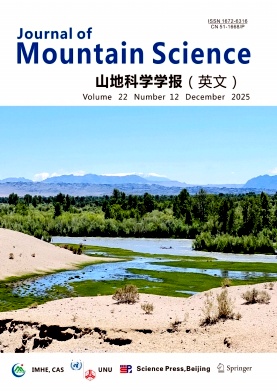
山地科学学报(英文版)(Journal of Mountain Science)
CN外文 - 月刊
  • 山地科学学报(英文版)(Journal of Mountain Science)
  • 复合影响因子:0.967
  • CSCD(2025-2026)科技核心(2025学术卷)
  • 知网,万方,维普
  • /有基金 100.0%
  投稿方式:官网投稿
  • 栏目频次
  • 一作占比
  • 单位占比
  • 热词

高频栏目

100%期平均发文量1篇
100%期平均发文量4篇
100%期平均发文量10篇
100%期平均发文量4篇

低频栏目

16.7%期平均发文量2篇
16.7%期平均发文量2篇
16.7%期平均发文量3篇
16.7%期平均发文量2篇
16.7%期平均发文量1篇
16.7%期平均发文量2篇
16.7%期平均发文量2篇
100.0%
暂无单位信息.
暂无关键词信息.
  • 更多

    期刊简介

  • 《山地科学学报(英文版)》(Journal of Mountain Science)(月刊),2004年创刊,由中国科学院主管,中国科学院、水利部成都山地灾害与环境研究所主办,科学出版社出版,Springer海外独家发行。重点关注世界高山及其边缘生态区的研究,主要报道在自然条件和人类活动影响下山地环境演变与可持续发展方面的研究论文。

  • 基本信息

  • 期刊名称:山地科学学报(英文版)(Journal of Mountain Science)
  • 主管单位:中国科学院
  • 主办单位:中国科学院、水利部成都山地灾害与环境研究所
  • 国内刊号:CN 51-1668/P
  • 国际刊号:ISSN 1672-6316;EISSN1993-0321
  • 出刊日期:
    期刊定价:
  • 邮发代码:
  • 所在省区:四川
    邮政编码:
  • 联系地址:

  • 投稿信息

  • 学科分类:天文地球科学
    版面费用:待核实
  • 字数要求:20000-44000
    查重要求:- ;AIGC检测:-
  • 复合因子:0.967
    综合因子:0.624
  • 审  稿 费:待核实
    稿费:待核实
  • 本刊可发:
  • 特殊属性:第一批认定学术期刊

  • 联系方式

  • 投稿网址:https://mc03.manuscriptcentral.com/jmsjournal
  • 官网网址:http://jms.imde.ac.cn
  • 电话传真:028-85252044(202512期)
  • 电子邮箱:jms@imde.ac.cn(202512期)
  • 微信公众号:山地科学学报

审稿时间:暂无参考数据,审稿时间不确定!

投稿难度:网友分享,仅供参考

见刊周期:-

温馨提示以上只是参考信息,实际情况会根据投稿主题、稿件质量和数量、审稿流程有所差异。想获得更准确信息请联系期刊的编辑部进行咨询。

欢迎点评!让信息更透明,使投稿更轻松!
    • 审稿时间:
      是否录用:
    • 发表排期:
      查重要求:
    • 有无课题:
      有无回复:
    • 我的学历:
      我的职称:
    • 审稿费用:
      版面费用:
    • 稿       费:
      稿件字数:
    • 投稿难度:
    • 该刊可发:
    • 投稿主题:
匿名: 验证码: 点击切换验证码
    • 1、投稿方式:在线投稿。

      2、刊内网址(202512期):

      http://jms.imde.ac.cn

      https://www.springer.com/11629

      https://link.springer.com/journal/11629

      3、投稿系统:

      https://mc03.manuscriptcentral.com/jmsjournal

      4、刊内电话:028-85252044

      5、刊内邮箱:jms@imde.ac.cn

      6、出刊日期:月刊,每月出版1期。

      7、官方微信公众号:山地科学学报

      8、官网QQ:1540631665

       官网QQ群:232951752

      2026年1月28日星期三

      Guides to Authors

      【官网信息】

      1. Aims and Scope

      Journal

      of Mountain Science (JMS) is devoted to mountains and their surrounding

      lowlands - ecoregions of particular global importance, with a

      particular emphasis on the important highlands/ mountains in the world,

      such as the Tibetan Plateau, the Himalayas,the Alps, the Andes, the

      Rockies and many other mountain ranges of our planet.

      This

      journal pays particular attention to the relationships between mountain

      environment changes and human activities, including the processes,

      characteristics and restoration of mountain ecosystem degradation;

      dynamic processes, and the theory and methods of controlling mountain

      hazards, such as debris, landslides and soil erosion; key scientific

      issues involved in large project construction in the mountain areas; the

      protection and development of special mountain resources; culture

      diversity and local economic development in mountain regions; and ethnic

      issues and social welfare in mountain areas.

      We

      especially welcome papers which emphasize the application of new

      technologies in mountain research and development, and the papers on new

      concepts and new methods deriving from disciplinary, interdisciplinary

      and transdisciplinary research in mountains.

      2. Article Categories

      All

      articles are assigned a type, depending on the content of the article.

      Editors have the final say on which type should be assigned to an

      accepted article.

      1. Original Article

      Original

      Articles are academic papers that display universal, strategic and

      innovative characteristics in both theory and practice. The work should

      report scientifically sound experiments and provide a substantial amount

      of new information. The article should include the most recent and

      relevant references in the field. The structure should include an

      Abstract, Keywords, Introduction, Materials and Methods, Results,

      Discussion, and Conclusions sections, with a suggested minimum word

      count of 4000 words.

      2. Review

      Review

      papers are high scholarly contributions articles written by experts who

      not only know very well the research and technical developments in the

      field but also are able to critically examine the state-of-the-art and

      express informed views and provide guidance/ideas of future developments

      of the research topic.

      If you are considering writing a review paper, please take into consideration the following:

      Potential

      authors should contact the Executive Editor-in-Chief (EEIC) to ensure

      the proposed review article is within the current aims and scope of the

      journal.

      Potential

      authors should provide: (i) the title of the review paper; (ii) a

      detailed reason why, in the light of the state of the art, the review is

      needed; (iii) a brief description of the contents of the paper

      including, chapter titles.

      The

      EEIC will evaluate the proposal and contact the authors with a decision

      on the matter. If the authors are invited to submit a full review

      paper, some preliminary feedback will be provided.

      3. Technical Reports

      Research/technologies/case

      studies/practices which will contribute to the disaster risk reduction

      of geohazards, or eco-restoration of degraded mountain environment other

      than the previous two categories. The structure is similar to an

      article but permits a higher degree of flexibility. The suggested

      minimum word count is 3500 words.

      4. Communication

      Communications

      are short articles that present groundbreaking preliminary results or

      significant findings that are part of a larger study over multiple

      years. They can also include cutting-edge methods or experiments, and

      the development of new technology or materials. The structure is similar

      to an article and there is a suggested minimum word count of 2000

      words.

      5. Perspective

      Perspectives

      are usually an invited type of article that showcase current

      developments in a specific field. Emphasis is placed on future

      directions of the field and on the personal assessment of the author.

      Comments should be situated in the context of existing literature from

      the previous 3 years. The structure is similar to a review, with a

      suggested minimum word count of 3500 words.

      6. Opinion

      Opinions

      are short articles that reflect the author’s viewpoints on a particular

      subject,technique, or recent findings. They should highlight the

      strengths and weaknesses of the topic presented in the opinion. The

      structure is similar to a review; however, they are significantly

      shorter and focused on the author’s view rather than a comprehensive,

      critical review. The suggested minimum word count is 2000 words.

      7. Conference Report

      Conference

      reports are records of the events of a conference, seminar, or meeting.

      They should provide a comprehensive overview of a meeting or session,

      along with relevant background information for the reader. The structure

      should contain Abstract, Keywords, Introduction, Conference Sections,

      and Concluding Remarks, with a suggested minimum word count of 2500

      words. They can also include all accepted meeting abstracts.

      8. Project Report

      Project reports are short and/or rapid announcements of project results and implications.

      They

      should include a research strategy or approach, the activities,

      technologies, and details of the project undertaken, conclusions, and

      recommendations for the future direction of work in the field. The

      structure is similar to an article, but permits a higher degree of

      flexibility. The suggested minimum word count is 3500 words.

      9. Book Review

      Book

      reviews are short literary criticisms analyzing the content, style, and

      merit of a recently published book. Full book details should be

      provided at the beginning of the article. The structure should only

      include an Introduction and be a discussion of critical points with no

      sections or conclusions, with a suggested minimum word count of 500

      words.

      All

      published items will be assigned a digital object identifier (DOI) and

      be citable, and posters, videos, or PPT presentations can be published

      together as the Supplementary Materials.

      ......

      更多详见:

      https://link.springer.com/journal/11629/submission-guidelines


    评分:0

    验证码: 点击切换验证码